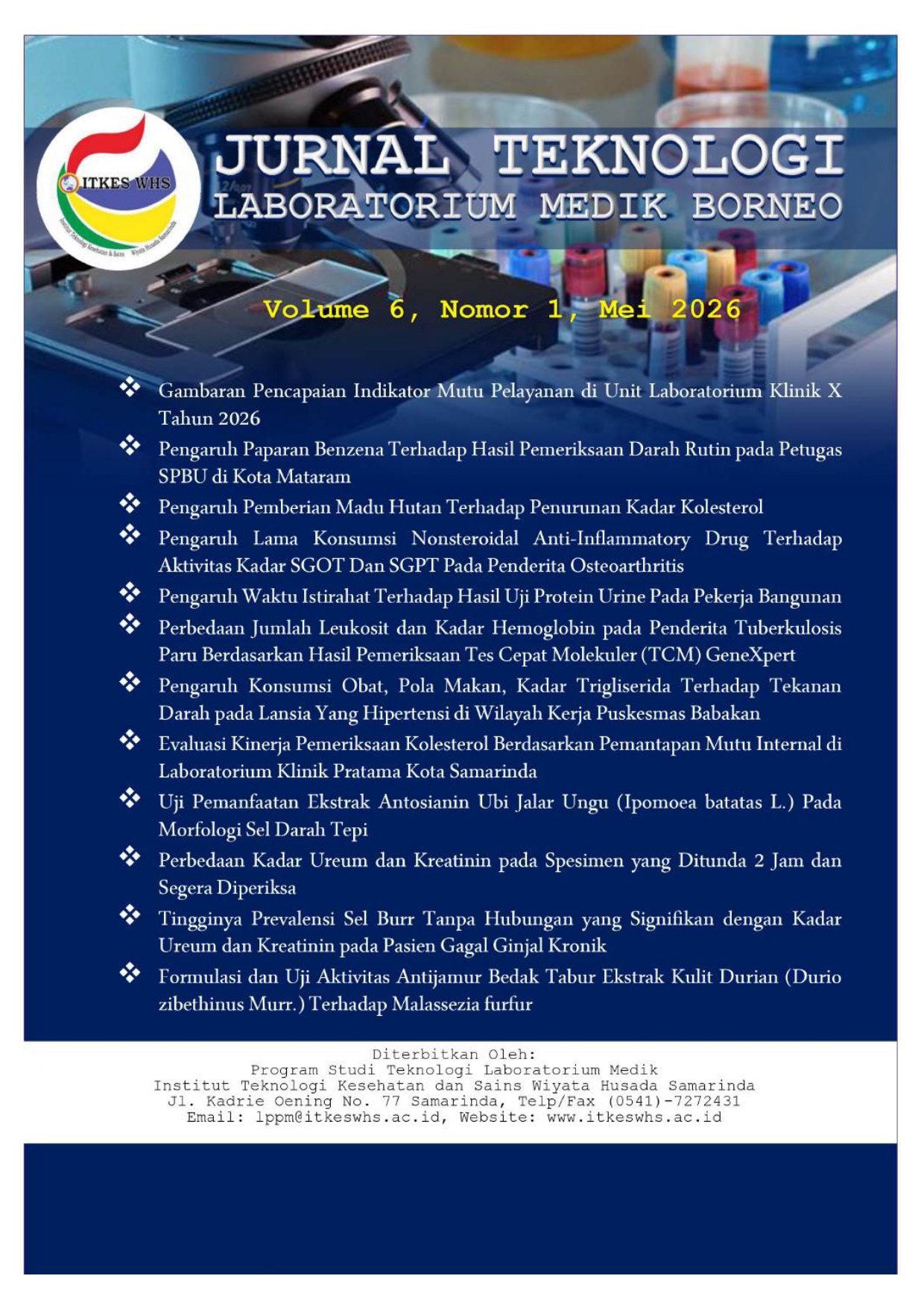
Tingginya Prevalensi Sel Burr Tanpa Hubungan yang Signifikan dengan Kadar Ureum dan Kreatinin pada Pasien Gagal Ginjal Kronik
High Prevalence of Burr Cells Without Significant Association with Urea and Creatinine Levels in Chronic Kidney Disease Patients
DOI:
https://doi.org/10.35728/qjk8g725Kata Kunci:
gagal ginjal kronik, Ureum, Kreatinin, Sel Burr, EritrositAbstrak
Latar Belakang: Gagal ginjal kronik (GGK) merupakan masalah kesehatan global dengan angka morbiditas dan mortalitas yang tinggi. Penurunan fungsi ginjal menyebabkan akumulasi ureum dan kreatinin dalam darah serta dapat memicu perubahan morfologi eritrosit seperti sel burr. Tujuan: Penelitian ini bertujuan untuk menganalisis hubungan antara kadar ureum dan kreatinin dengan temuan sel burr pada pasien GGK. Metode: Penelitian ini menggunakan desain deskriptif analitik dengan pendekatan cross-sectional. Sampel penelitian berjumlah 51 pasien GGK yang dipilih menggunakan teknik total sampling. Data diperoleh dari hasil pemeriksaan laboratorium berupa kadar ureum, kreatinin, dan apusan darah tepi. Analisis data dilakukan menggunakan uji korelasi Pearson dan regresi linier berganda dengan tingkat signifikansi 0,05. Hasil: Hasil penelitian menunjukkan bahwa rerata kadar ureum dan kreatinin berada di atas nilai normal. Sebagian besar pasien (74,5%) menunjukkan adanya sel burr pada apusan darah tepi. Namun, hasil uji statistik menunjukkan tidak terdapat hubungan yang signifikan antara kadar ureum dan kreatinin dengan temuan sel burr (p > 0,05). Analisis regresi juga menunjukkan bahwa kedua variabel tersebut tidak berpengaruh secara simultan terhadap keberadaan sel burr. Kesimpulan: Kadar ureum dan kreatinin tidak berhubungan secara signifikan dengan temuan sel burr pada pasien GGK, sehingga tidak dapat digunakan sebagai prediktor langsung perubahan morfologi eritrosit
Referensi
Ávila, M., Mora Sánchez, M. G., Bernal Amador, A. S., & Paniagua, R. (2025). The metabolism of creatinine and its usefulness to evaluate kidney function and body composition in clinical practice. Biomolecules, 15(1), 41. https://doi.org/10.3390/biom15010041
Babitt, J. L., & Edelstein, C. L. (2021). Intrarenal mechanisms of chronic kidney disease progression. Nature Reviews Nephrology, 17(2), 87–104. https://doi.org/10.1038/s41581-020-00356-5
Bain, B. J. (2022). Blood cells: A practical guide (6th ed.). Wiley-Blackwell.
Chen, Y., Li, X., & Wang, J. (2022). Relationship between oxidative stress and erythrocyte morphology in chronic diseases. Oxidative Medicine and Cellular Longevity, 2022, 1–10. https://doi.org/10.1155/2022/1234567
Fouque, D., Kalantar-Zadeh, K., & Kopple, J. (2023). Nutritional management in chronic kidney disease: A review. Kidney International Reports, 8(4), 789–798. https://doi.org/10.1016/j.ekir.2023.01.012
Harrell, F. E. (2021). Regression modeling strategies (2nd ed.). Springer.
Kalantar-Zadeh, K., Jafar, T. H., Nitsch, D., Neuen, B. L., & Perkovic, V. (2021). Chronic kidney disease. The Lancet, 398(10302), 786–802. https://doi.org/10.1016/S0140-6736(21)00519-5
KDIGO. (2024). KDIGO 2024 clinical practice guideline for the evaluation and management of chronic kidney disease. Kidney Disease: Improving Global Outcomes.
Kim, S. H., Park, J. W., & Lee, M. H. (2023). Correlation of burr cells with declining glomerular filtration rate in chronic kidney disease patients. Journal of Nephrology and Renal Therapy, 15(2), 123–131.
Kovesdy, C. P. (2022). Epidemiology of chronic kidney disease: An update 2022. Kidney International Supplements, 12(1), 7–11. https://doi.org/10.1016/j.kisu.2021.11.003
Levey, A. S., Titan, S. M., Powe, N. R., Coresh, J., & Inker, L. A. (2022). Kidney disease, race, and GFR estimation. Clinical Journal of the American Society of Nephrology, 17(2), 259–267. https://doi.org/10.2215/CJN.12791021
Locatelli, F., Del Vecchio, L., & Cavalli, A. (2022). Uremic toxins and oxidative stress: A complex relationship. Toxins, 14(3), 200. https://doi.org/10.3390/toxins14030200
Park, J. H. (2021). Erythrocyte morphology changes in chronic kidney disease and their clinical significance. Clinical Hemorheology and Microcirculation, 78(3), 251–260. https://doi.org/10.3233/CH-201234
Sari, A. P., Rasyid, H., Harjianti, T., Bakri, S., Umar, H., Katu, S., & Zainuddin, A. A. (2024). Positive correlation of glomerular filtration rate with burr cells on peripheral blood smear examination in patients with chronic kidney disease. Gazzetta Medica Italiana Archivio per le Scienze Mediche, 183(1–2).
Steyerberg, E. W. (2022). Clinical prediction models (2nd ed.). Springer.
Tang, Y., Varavko, Y., Aringazina, R., & Menshikova, I. (2024). Changes in renal function and morphological variations of kidney diseases in rheumatoid arthritis patients. Asian Journal of Urology, 11(2), 304–310. https://doi.org/10.1016/j.ajur.2022.06.005
Vaidya, S. R., & Aeddula, N. R. (2025). Chronic kidney disease. In StatPearls. StatPearls Publishing.
Zhang, X., Wang, Y., & Liu, Q. (2021). Oxidative stress and morphological changes of red blood cells in chronic kidney disease. Clinical Hemorheology and Microcirculation, 79(1), 35–45. https://doi.org/10.3233/CH-201567
Zoccali, C., Vanholder, R., & Massy, Z. A. (2023). The systemic nature of chronic kidney disease. Nature Reviews Nephrology, 19(1), 1–15. https://doi.org/10.1038/s41581-022-00628-9
Unduhan
Diterbitkan
Terbitan
Bagian
Lisensi
Hak Cipta (c) 2026 Pramudiatmoko, Yusuf Eko Nugroho, Ira Pangesti, Imam Agus Faizal

Artikel ini berlisensi Creative Commons Attribution-NonCommercial 4.0 International License.